|
|
Timing Modes
| Delay On Break
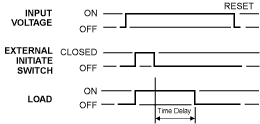
Often called Off Delay, Delay on Release, Delay on De-Energization.
Power is continuously applied to the input terminals of the timer. Upon closure of a normally open (N.O.) external initiate switch, the load transfers immediately and remains transferred as long as the external initiate switch is closed. Starting the time delay is deferred by maintained closure of the external initiate switch. The time delay is started instantly by opening the initiate switch. At the end of the delay period, the load de-energizes and the timer is ready for another cycle. Delay time may be reset to beginning, prior to the end of the delay period, by momentarily reclosing (pulsing) the initiate switch.
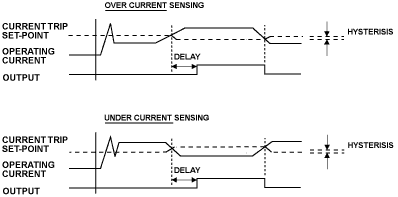
Current Sensor
When the sensed current increases above or falls below the set-point, the time delay will start. At the end of the delay, the output will be energized.
|
|
Repeat Cycle
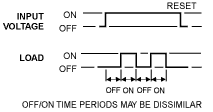
Often called Recycle Timer, Delay On Operate and On Release, On/Off Dual Delay, Dual-Delay Energization.
Application of power to the input voltage terminals starts the “Off” delay cycle. At the end of the “Off” delay period, the load is energized and the “On” delay starts. At the end of the “On” cycle, the load is de-energized, the timer returns to the “Off” cycle and the cycling is repeated as long as input voltage is applied. Removal of input voltage will reset the timer to its pre-power condition.
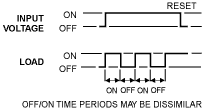
Similar to "Repeat Cycle Off/On Delay" except that the "On" cycle is initiated first when power is applied.
Application of power to the input voltage terminals starts the “On” delay cycle instantly causing the output to change state. At the end of the “On” delay period, the load is de-energized and the “Off” delay starts. At the end of the “Off” cycle the load is energized, the timer returns to the “On” cycle and the cycling is repeated as long as input voltage is applied. Removal of input voltage will reset the timer to its pre-power condition.
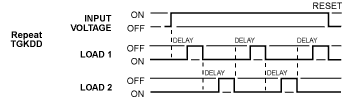
Application of power to the input voltage terminals starts the “Off” delay cycle. At the end of the “Off” cycle, load 1 is energized.this is the “On” cycle. At the end of the “On” cycle, load 1 de-energizes and another “Off” cycle starts. At the end of this “Off” cycle, load 2 is energized for an “On” cycle. This alternating output action continues until power is removed.
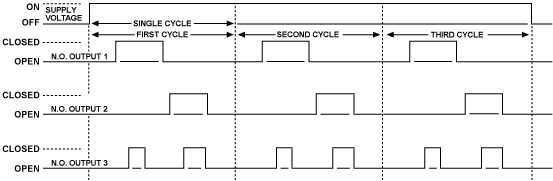
ELECTRONIC CAM (Typical 3 Output Unit Diagram)
Apply power to input terminals. Unit will emulate a mechanical motor timer and will reset back to the start position with the removal of power.
|
|
Single Shot
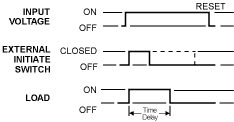
Often called Single Shot, Latching Relay, Latching Off Delay, Latching Delay on De-Energization.
The term “Single Shot” signifies a single pulse output of some duration. Power must be applied to the input voltage terminals continuously. Upon closure of a Normally Open (N.O.) external initiate switch, the load is instantaneously energized and the time delay cycle starts. Maintained closure or actuation of the external initiate switch during the delay cycle will not affect the time delay period. When the delay period expires, the timer will reset to its original position and is ready for another cycle.
|
|
Interval On
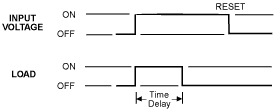
Often called Interval, Interval Dealy, Delay on Energization with Instantaneous Transfer.
When power is applied to the input voltage terminals, the load is energized immediately and the time delay cycle starts. At the end of the delay period, the timer transfers back to its pre-power position. Removal and re-application of input voltage resets the timer.
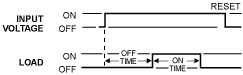
Delayed Interval
Application of power to the input terminals starts the “Off” time. When this time is complete, the load energizes for the “On” time. At the end of the “On” time, the load de-energizes and remains in this state until the input power is removed and reapplied to start a new timing cycle. Both time periods can be individually adjusted.
|
|
True Off
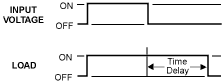
Application of the supply voltage energizes the output relay. The timing period begins upon removal of the supply voltage. At the conclusion of the timing period, the output relay is de-energized. Reapplication of input voltage before the delay expires resets the time period.
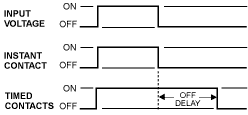
Apply input power for a minimum of 100 milli-seconds to assure time out. Instantaneous contact and timed contacts transfer. Remove input power, instantaneous contact drops out, timed contacts remain closed for duration of selected time (off-delay) then drop out. Reapply power for new cycle.
|

True Off Make Timers

|
|

