
Mini
Fixed Point Cells, Temperature
Calibration, Primary Standards

|
|
Mini
Fixed Point Cells, Temperature
|
|
|
|
| Mini Fixed Point Cells, Temperature Calibration, Primary Standards |
| Mini Fixed Point Cells - Model 5914 - 5919 |
|
Features |
|
|
|
|
Specifications |
|||||||
|
|
|
|
|
Expanded Uncertainty (mK) |
|||
|
|
Simple
|
||||||
|
5914 |
M.P. In |
156.5985 |
140 |
1.0 |
3.0 |
2.0 |
5.0 |
|
5915 |
M.P. Sn |
231.928 |
140 |
1.4 |
3.0 |
3.0 |
5.0 |
|
5916 |
M.P. Zn |
419.527 |
140 |
1.6 |
4.0 |
4.0 |
7.0 |
|
5917 |
M.P. Al |
660.323 |
140 |
4.0 |
6.0 |
10.0 |
12.0 |
|
5918 |
M.P. Ag |
961.78 |
140 |
7.0 |
12.0 |
20.0 |
25.0 |
|
5919 |
M.P. Cu |
1084.62 |
140 |
15.0 |
20.0 |
40.0 |
45.0 |
|
1 “Cell Only” refers to the expanded uncertainty of the cell when realized in a deep-immersion lab furnace using the freezing-points. “Simple Realization” uses the melting-point technique and a temperature source with less immersion depth than a lab furnace, such as a 12-inch bath or portable furnace. |
|||||||
|
2 Distance from the bottom of the central well to the surface of the pure metal. |
|||||||
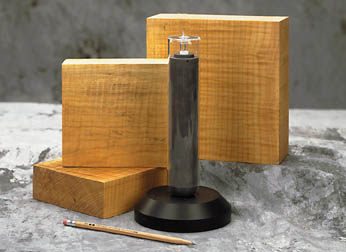 If
cute was reason enough to buy a product, Hart’s diminutive Fixed Point Cells
would win you over easily. But there’s a much better reason to buy them: they
give you the least expensive, easiest-to-use fixed-point primary standards
for your lab.
If you’re calibrating industrial thermometers, thermocouples or thermistors
and want the most accurate calibration possible, these cells will give it
to you. Work with them at their designated freeze-point, or use them at their
melting point to simplify the calibration process even further. We published
a paper, “The Comparison Between the Freezing Point and Melting Point of Tin,”
to help you understand and benefit from the easier procedure of using the
melting point of your standard.
These mini-cells are made from the same materials and with the same procedures
as their full-size counterparts. If you use the same freeze techniques with
these cells as you do with our other metal fixed-points, you will achieve
the same uncertainty levels.
Mini-cells eliminate the need for comparison calibrations. Temperatures of
fixed-point cells are constant and intrinsic at their melting point, so only
the electrical parameters of the sensor under calibration need to be read.
The cells can be maintained in Hart’s liquid baths, furnaces and mini-cell
apparatus, all of which can be automated for bringing the cells to their melting
or freezing point without attention from you.
In addition to high-accuracy calibrations of RTDs and PRTs, these cells are
perfect for validating the accuracy of SPRTs. If you’re doing comparison calibrations
with SPRTs, then you know the importance of occasionally checking their accuracy
in between sending your SPRTs out for their own recalibrations. Because these
cells are easy to use and maintain, verification checks are simple and convenient.
Hart manufactures mini-cells with two levels of uncertainty. We have cells
made with six 9s metal purity and cells with five 9s metal purity, depending
on your needs. The specifications table (at right) gives you the freeze temperature
of a particular metal and its uncertainty according to its purity.
You’ll find these cells easier to use than you expect. You can have a free
copy of Xumo Li’s paper comparing freeze-point measurements with melting-point
measurements, and if you want a high level of training in using these devices
or other metal freeze-point cells, you can attend one of Hart’s in-depth training
classes held in our lab in Utah.
Probes as short as nine inches work with these cells. Their overall dimensions
are:
Outer diameter of cell 43 mm
Cell length 213 mm
Inner diameter of central 8 mm well
Total immersion depth 140 mm
 |


