|
 A
Valve Positioner is the critical link between the controlling
elements in a plant and the final control element, the control
valve.
Important considerations when selecting a Valve Positioner
are:
The
Valve Positioner compares the valve/actuator position to a desired
input signal and influences the valve/actuator so that its position
corresponds with the desired input signal.
Valve
Positioners are often required to operate under difficult conditions
such as high vibration, extreme temperatures, corrosive environments,
poor air quality, and general abuse. Quite often, these products
are expected to perform to exact requirements, and remain maintenance
free, under these rugged conditions.
Design
A simple, clean design has made PMV one of the most accepted positioner
products on the market today. Engineers and maintenance people
have responded positively to the concept that in a positioner,
simpler is better. (back)
Performance
How well does the unit do what it claims it will do? Such characteristics
as gain, hysteresis, repeatability, and linearity are key elements
of the performance equation.
Performance should not only be evaluated with these engineering
terms and numbers, but with the real life world of actual plant
operations. Performance is what brings engineers and maintenance
people back to PMV. (back)
Reliability
How well does the positioner meet the performance specifications,
in the very difficult environment that control valves, actuators,
and positioners often find themselves?
Meeting the performance specifications, under difficult conditions,
helps determine the products reliability. (back)
Durabiilty
How long does the positioner maintain its specifications under
difficult environmental conditions? The life expectancy of all
industrial products is determined by the user.
Under the installed conditions, is the product durable enough
to meet the user's expectations?
(back)
Maintenance
There are no maintenance free industrial products that are installed
on control valve packages. Maintenance should be a function of
frequency and simplicity.
How often are you performing maintenance on your positioners?
How easy are they to maintain?
Two key elements to consider. (back)
|
Dynamic
Loop Performance - Valve Positioner Issues
|
Historically, comparison, and selection
of positioners has been based on performance criteria
expressed as a % of full signal span, i.e. 0-100% stroke
of the associated control valve.
|
In the last few years engineers have begun
to recognize that specification of traditional performance
criteria is incapable of determining, nor assuring, the
best installed performance of the control valve and entire
loop. The reason for this is simply that the overwhelming
majority of control valves operate either at a steady
state, or, when they do make an adjustment, make small
changes in position representing 5% of signal span, or
less.
|
While still important to predict a valve's
performance at min., normal and max. flows, full span
performance specifications cannot measure nor predict
a valve's/loop performance at the conditionswhere they
probably spend 99% of their operating time, either a steady
state or small adjustment in the area of 1-5% of signal
span.
|
Lack of consideration of the positioner's
narrow band performance ultimately denies users the full
benefit of digital process automation, defeating the inherent
precision of digital transmitters and controls.
|
|
Flow
Gain vs. Pressure Gain |
In addition to standard wide band performance
criteria such as accuracy, repeatability, hysteresis, etc.,
consideration and specification of both flow and pressure
gain can assure optimum performance in the critical narrow-band
control environment. To evaluate a positioner's (control valve)
narrow-band potential performance, it therefore becomes necessary
to consider both the flow and the pressure gain performance.
| As
an example, it can be easily demonstrated that a positioner
with 22 SCFM output and a pressure gain of 800:1 will
be less sensitive and slower in response to small signal
changes than a positioner with a rated output of only
18.5 SCFM, but a pressure gain of 1000:1. |
 |
|
|
Flow
Gain |
| It
has been, and remains, a common practice to measure
a positioner's potential performance by it's maximum
rated air delivery at a given supply pressure. Overlooked,
is the fact that a positioner's air delivery is actually
proportional to the amount of signal change whenever
the signal change represents 10% of signal span, or
less. The actual air delivery of a positioner is only
a small fraction of the max. rated output when signal
changes represents 5% of span, or less. |
|
|
|
Pressure
Gain |
Positioner
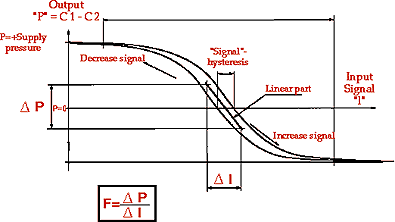
pressure gain is essentially it's ability to develop
an operating differential pressure to the valve actuator.
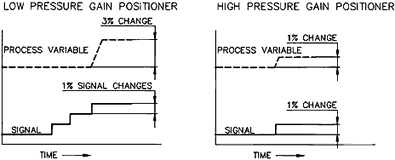
In essence, a positioner with a higher pressure gain
will be more sensitive to small signal changes and provide
noticeably faster valve response in the critical area
of 1-5% signal changes. |
|
|
 Click here
to view pdf file

Back
to Valve Positioners | Back to
Top
|