New
treatment standards for effluent re-use in
Coffs Harbour, Australia
 Amiad
recently commissioned a tertiary filtration and treatment
system for the Coffs Harbour City Council (CHCC). The filtration
system provides a tertiary treatment of secondary treatment
effluent.
Coffs Harbour is a coastal town in
Northern New South Wales, Australia with a population of 60,000.
The need for tertiary filtration evolved as a result of the
community's interest in better environmental solutions for
effluent reuse and reduced discharge via ocean outfall.
Due to the diverse range of users
within the re-use water reticulation system, flow demands
upon the system vary widely (18 - 318 m³/hr). The system
has to provide a water quality that conforms with the current
Environmental Protection Authority guidelines for effluent
re-use, which are thought to be the toughest in the world.
System
Overview
The process begins with pre-filtration
of the secondary effluent with an Amiad "EBS" automatic self-cleaning
filter. Adjacent to this pre-filter, secondary chlorine injection
is undertaken in order to oxidize organic and bacterial content.
 Further downstream, alum is injected and subsequently mixed.
The physical separation of this process from the media filtration
site provides necessary contact time for both the chlorine
and alum.
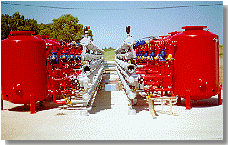
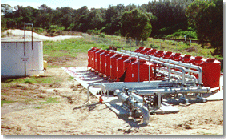
The heart of the process is the filter
site which comprises 18 of the Model 97 filter vessels. The
Amiad design provides a modular system of 18 deep-bed media
filters. Each vessel is equipped with a valving control assembly
that ensures a balanced flow throughout the system.
The hydraulic balance in each vessel
guarantees the designed filtration speed to be maintained
without human intervention. The filtration speed is a critical
part of the process in achieving the required NTU level..
The filtration process has been enhanced
by using three different media types within each vessel. The
media performance is aided by an air scour prior to back washing.
Clean filtered water is used for the back-wash process, which
is then returned to the humus tanks for further recycling
via the secondary process.
The final step in the process, prior
to delivery to the council's end users, is the tertiary chlorination
of the filtered effluent. The dosing system for all chemicals
is flow based, allowing the accurate input of chemicals across
the flow range of 18 - 318 m³/hr. To ensure health and
safety to it's clients, the council has specified a faecal
coliforms level <10/100 ml, regardless of flow. Amiad's
system is currently achieving a quality even better than this.
A custom built switchboard and control
system has been installed to operate and monitor every aspect
of the system's performance. It has full remote reporting
capability and the program can be accessed via modem, providing
24 hour support as required.
The re-use of water is employed in
a full range of activities: watering sporting fields, golf
courses, parks and gardens, as well as in roadmaking.
Amiad is proud to be associated with
these new environmental standards for effluent filtration,
and for being involved with projects that have significant
tangible benefits for both the community and the environment.



