Emergency pumping systems
restart industry after flood.
Saguenay disaster emergency response
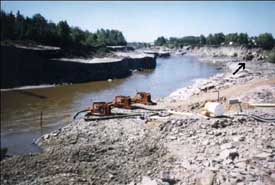
On Saturday, June 20, 1996, extremely heavy rains caused flash flooding along several rivers in the Saguenay Valley, north of Quebec City, with disastrous effects on people, property and industry. As dams failed at retention lakes, tidal waves bore down the rivers and literally scoured the riverbanks along their path. Municipal and industrial pumping stations disappeared in minutes. As a result, temporary emergency pumping was required for both domestic and process water. Without a proper supply of water, these plants cannot produce, and being the mainstay of the local economy, over 5,000 of their directly affected employees were out of work overnight.
On Sunday, June 21st, a project engineer from RMS Enviro Solv Inc. contacted the site engineer responsible at one of these major plants and confirmed their ability to deliver temporary major pumping systems in the shortest possible delay. Access to the plant and a review of the damage was impossible at that time. On Monday morning, it was discovered that the main plant pumping station located at the river was gone (see above at arrow on top right of photo).
Their emergency response team called on RMS to supply temporary pumping facilities. Having used RMS on a successful sewer by-pass some two months earlier, they were aware of the reliability of the Godwin Dri-Prime pumps and of RMS service.
Along the Chicoutimi River bed, now some five meters lower than before, a temporary pump placement pad was constructed with a 12-inch distribution header. Diesel driven pumps, cargo hose and Q-D piping were delivered overnight.
Two days later, two Godwin Dri-Prime HL-10 and two HL-6 High Head centrifugal pumps with hose and 2,500 feet of Bauer quick-disconnect galvanized steel piping and bends were onsite, ready for startup.
Components were assembled and tested under the supervision of an RMS service representative. The HL-10’s provided pumping from the river to the quickly constructed sedimentation ponds, while the HL-6’s pumped from the ponds to the plant. Initial system capacity was 4,000 usgpm @ 185 feet tdh.
The plant started to come back on-line within only five days of the flood. Two more HL-10’s and lots more of 12-inch cargo hose were brought in during the following two weeks, feeding the plant with 12,000 usgpm @ 70 psi.
Most plant departments were back on-line within three weeks of the disaster. Engineering personnel were then able to concentrate on building a new replacement pump station.
The Dri-Prime temporary pumping system operated uneventfully, 24 hours a day for five months. Normal lubrication and preventative maintenance was done onsite.
Comments from plant management and engineering personnel included: "pleased with the immediate and professional response from RMS and the performance and reliability of the Godwin Dri-Prime pumping systems. This allowed a lot of people to get back to work quickly and minimized our shareholder’s losses."


