|
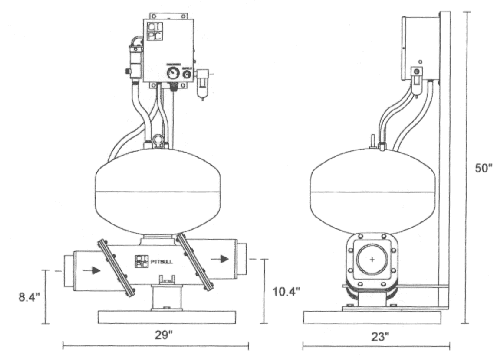
Pitbull Model T4C and T4S
4"x 4" Transfer and Self-Priming Pumps
The model T4C (steel) and T4S (316SS) are transfer pumps designed for dry-piped applications, and can be either gravity fed or configured for suction
lift applications. The T4’s are suited for heavy/constant use in difficult fluid applications. Able to pass 3.5” solids along with abrasives, stringy materials, slurries and corrosives, the Pitbull’s simple, seal-less design is the solution to many high maintenance applications.
Typical applications includes tank car unloading, tank sludge, ash, scale, san and abrasive slurries, vacuum drum filters, clarifier underflow, trash and solids.
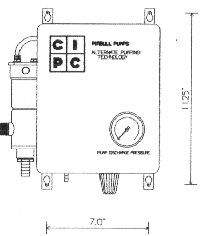
Each pump comes complete with the AP200 pneumatic control panel mounted to the pump frame, with exhaust and sensing lines connected. Pumps can also be equipped with a self-priming option for suction lifts up to 15’ (@ 1.0 S.G.).
Specifications
- Weight: 170 lbs
- Piping: 4" NPT
- Control panel: AP200 (all-pneumatic)
- Volume: 13 gallons (US)
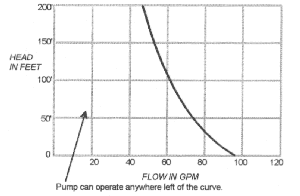
- Maximum discharge head: 100 psi
- Maximum solid: 3.5" diameter
- Lowest submerged operating level: 26” (liquid depth)
-
Maximum suction force (optional): 15 feet @ 1.0 sg
Requirements
- Compressed air or dry gas, > 40 psi
- 1/2” npt air supply inlet
Model and Options Selection:
Part Number Ø
T4 __/ __/ __
Standard units:
#T4C = a steel submersible pump with steel checks and nitrile seats.
#T4S = a 316SS submersible pump with 316SS checks and nitrile seats.
Optional examples:
#T4C/E/SP = a steel, 2” transfer pump with steel checks, EPDM seats and self-priming option
A complete pump contains: pump, inlet and discharge check valves, an AP200 control panel and 15’ of nitrile/polyester braided airlines (3)
Description of options:
‘SP’ self-priming. This is an air powered, vacuum generator mounted to the exhaust valve of the controlpanel. It is operated by a manual ball valve: ‘open’generates full suction lift, ‘closed’ the pump runs as a standard, gravity fed unit.
Valve seat selection:
Nitrile -Good all-purpose elastomer. Medium chemical, oil and solvent resistance, good strength, use to 170°F.
Viton -Excellent resistance to oxidizers and solvents. Medium strength, use to 250°F.
Teflon -Best chemical resistance of all. Inert to acids, bases and solvents. Lower cycle life, non-elastomeric, use to 300°F.
Urethane -Best resistance to abrasion. Toughest of the elastomers, with mild chemical resistance, use to 150°F.
EDPM -Good head and acid/base resistance.
Tougher than viton but poor solvent resistance, use to 300°F.
SELF-PRIMING NOTES
Flow rates are based upon 4" or less of suction lift. Deduct approximately 10% from the rated flow for each 1.5'
of suction lift greater than 4'.
On/Off of the self-priming is controlled by a ball valve. Air valves controlled by level controls or other inputs can be used
SELF-PRIMING AIR USAGE
The air consumption chart is based upon gravity fed conditions. Using the self-priming option will increase air consumption 8 - 15 SCFM depending on the suction lift and flow required. Minimum pressure required to create suction lift is 50 psi, with maximum performance at 80 psi
AIR CONSUMPTION CHART
Headè
êFlow |
10 ft
|
20 ft
|
40 ft
|
60 ft
|
80 ft
|
100 ft
|
140 ft
|
180 ft
|
220 ft
|
| 10 gpm |
2
|
2.4
|
3.2
|
4.1
|
4.9
|
5.8
|
7.5
|
9.3
|
11
|
| 20 gpm |
3.8
|
4.7
|
6.4
|
8.1
|
9.9
|
11.6
|
15.1
|
18.5
|
22
|
| 30 gpm |
5.7
|
7
|
9.6
|
12.2
|
14.8
|
17.4
|
22.6
|
27.8
|
33
|
| 40 gpm |
7.6
|
9.4
|
12.8
|
16.3
|
19.7
|
23.2
|
30.1
|
37.1
|
44
|
| 60 gpm |
11.4
|
14
|
19.2
|
24.4
|
29.6
|
34.8
|
45.2
|
55.6
|
66
|
| 80 gpm |
15.2
|
18.7
|
25.6
|
32.6
|
39.5
|
46.4
|
60.3
|
74.1
|
88
|
| 100 gpm |
19
|
23.4
|
32
|
40.7
|
49.4
|
58
|
75.3
|
92.7
|
110
|
| 140 gpm |
26.6
|
32.7
|
44.8
|
57
|
69.1
|
81.2
|
105.5
|
129.7
|
154
|
Example shown: 80 GPM @ 40 ft TDH requires 25.6 SCFM
|
 AP200 Control Panel
Commonly Asked Installation/Application Questions
How is the pump controlled?
On-Off should be controlled by opening or closing the liquid supply. Without liquid, the pump will not cycle (do not cut off the air supply – the pump will fill and not be able to pressurize)
Can the flow rate be controlled?
Yes, three different ways.
(1) throttle the inflow to slow the cycle rate;
(2) throttle the exhaust to slow the fill rate;
(3) adjust the air pressure to control the discharge flow rate.
Can the piping be reduced?
Smaller piping causes higher head and velocity, and the pump may pass things the piping can’t. Try to avoid dropping more than one pipe size.
Should isolation valves be used before and after the pump?
Absolutely.
How does the self-priming work?
By sucking the air out of the pump, much like a vac truck, or vacuum cleaner. CIPC uses a venturi principle to create the vacuum, without any moving parts.
|