|
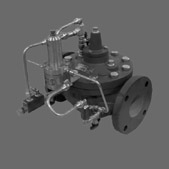  Pressure
Differential Sustaining Valve
Model
106-RPS-D & 206-RPS-D
The
valve shall be installed in-line. It shall automatically
open when the pressure differential across the
valve exceeds the pilot setting. When open the
valve modulates to limit the flow through the
valve in order to maintain the desired pressure
differential.
Specifications
Model 106-RPS-D & 206-RPS-D Pressure Differential
Sustaining Valve
The
valve shall be a Singer model 106 (206) –
RPS-D, Pressure Differential Sustaining valve,
size ____” (mm), ANSI Class 150 (300) flanged
(screwed), globe (angle) style, with ANSI B16.42
pressure rating of 250 (600) psi. The valve shall
be installed in-line and automatically open when
the pressure differential across the valve meets
or exceeds a pre-determined (adjustable) setting.
The
main valve shall be constructed of ASTM A536 ductile
iron and coated inside and out with an NSF61 approved
fusion epoxy. The valve stem and seat ring shall
be constructed of stainless steel. The valve shall
come complete with Model 81-RPD pressure differential
pilot, spring range 20 to 200 psi, (5 to 25, 10
to 80, 100 to 350) factory set at _____ psi. The
pilot system shall be assembled according to Schematic
A0428.
Prior
to shipment, the standard tests shall include
a pressure test and a full function, operational
test. The entire valve shall be covered by a three
(3) year limited warranty against defects in materials
and workmanship. The stainless steel seat ring
shall be covered by Singer Valve’s exclusive
LIFETIME replacement warranty.
Function:
The
valve shall be hydraulically operated, globe (or
angle) pattern and installed in-line. It shall
automatically open when the pressure differential
across the valve exceeds the pilot setting. When
open the valve modulates to limit the flow through
the valve in order to maintain the desired pressure
differential
Main
Valve Characteristics:
All
valves shall be constructed of ASTM A536-65/45/12
ductile iron, rated to ANSI Class 150 or Class
300 maximum operating pressures of 250 psi and
600 psi respectively. Every valve shall come internally
lined and externally coated with an NSF61 approved
fusion epoxy coating. All repairs shall be possible
without removing the valve from the line.
The
inner valve assembly shall be top and bottom guided
by means of easily replaceable bearing bushings.
The inner assembly shall be the only moving part
and securely mounted on a stainless steel stem
with wrench flats to simplify assembly. Each stem
shall be machined ready to accept the optional
position indicator or limit switch assembly. The
inner valve assembly shall operate in the vertical
plane and seal perpendicular to the seat.
For
smooth “frictionless” motion, actuation
shall be by diaphragms, either flat or rolling
type, constructed of nylon fabric, bonded with
synthetic rubber. The diaphragms shall not be
used as a sealing surface. All diaphragms shall
meet or exceed a Mullen Burst Test of 1500 psi.
No lip seals, o-rings or packing may be used to
seal the actuator.
The
seating shall consist of a mechanically held,
rectangular cross-section, synthetic rubber resilient
disc and an erosion resistant, stainless steel
stationary seat. The seat shall be bolted into
place and have a warranty for the life of the
valve. No special tools will be required to work
on any part of the valve.
The
valve cover shall have a separate removable spring
cap giving access to the stem for alignment check
and ease of assembly.
Each
valve shall be tested prior to shipment. The shop
tests shall include a pressure test and a functional
operational test. Pilots shall be preset as specified.
All valves shall come with a three (3) year warranty
and an exclusive LIFETIME replacement warranty
for the stainless steel seat.
Pilot
System Characteristics:
The
main valve shall be complete with a fully functional
pilot system assembled according to Schematic
A0428.
The
pilot system shall include the model 81-RPD direct
acting, spring and diaphragm actuated pressure
differential pilot. This normally closed pilot
is constructed of ASTM B16 brass with stainless
steel seat and Buna N diaphragm and seals. It
shall have a spring range of 20 to 200 psi (5
to 25, 10 to 80, 100 to 350) and be factory set
to XXX psi.
The
pilot system shall come complete with the following
ancillary components:
a) Model 852-B closing speed control needle valve.
b) Pilot system strainer with 40 mesh stainless
steel screen and a built-in blowdown/cleaning
port.
c) Isolating ball valve(s) standard at downstream
connection of pilot system on all sizes. (Inlet
and bonnet isolation ball valves are also standard
on valves 4” and larger)
|


