|
|
|
MIXM™
Vertical Mixers for Mixing Fluids
|
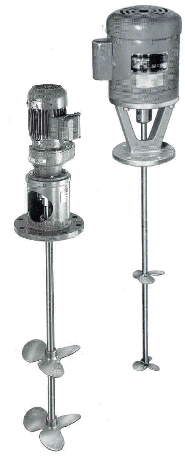 Midwest
Mixing Inc.,
builds Vertical Mixers in various styles and designs: direct
drive, geared, electrical or air driven (at speeds suitable)
for the impellers used, the tank dimensions, the mixing objectives,
and the fluids involved). Mountings can be furnished for use
on tanks made of steel, fiberglass, wood or other materials,
open or closed, with or without vacuum or pressure, jacketed
or non-jacketed, with or without internal heating elements.
Tanks should preferably be cylindrical, with height equal
to diameter. Otherwise, power requirements and number of mixers
may vary. Propellers may not be used in extremely shallow
tanks. Shaft diameters are selected with critical speed considereations
in mind. Steady or foot bearings or stabilizers may also be
required. Other factors such as flash point, settling rates,
head room, viscosity, uniformity, sensitivity to shear, particle
size reduction, etc., must be considered in selecting the
proper mixer type and size.
Motors are
constructed to NEMA standards, and are available: continuous
duty; foot or face mounted constant/multi/variable speed;
AC, D.C.; open; totally enclosed or explosion-proof, as required.
Motors can include all standard electrical characteristics
and are used either directly, or with speed reducers, to provide
the speed required by the application and the impeller used.
AIR MOTORS may be a very important alternative to electric
motors. Hydraulic motors can also be supplied.
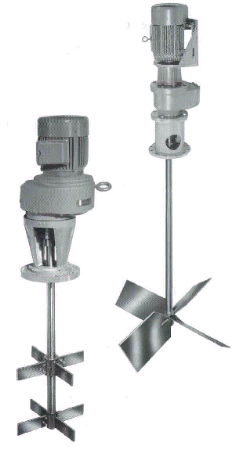 Speed
Reducers conform to AGMA standards
and are designed specifically for mixing applications for
the service class indicated. Gear housings are made of close-grained
free machining aluminum alloy or close-grained semi-steel
machined to interchangeable tolerances and close bearing-fits.
Seals are double lipped and suitable for the lubricant used.
Provision is made for easy addition or drainage of lubricant
used. Provision is made for easy addition of drainage of lubricant
and measurement of its level. Helical and/or spiral bevel
gears are normally used (with hardened and ground teeth for
strength and long wear). Where thrust loads require them,
tapered roller output shaft bearings are used. Compact design
high mechanical efficiency and smooth, quiet operation are
always our prime objective.
Variable Speed may be accomplished
electrically through the use of DC motors and SCR rectifier/speed
controllers, for operation from AC sources; or through AC
motors and variable frequency controllers. Mechanically, speed
may be varied with variable pitch pulleys or with various
cone, disc or fluid speed variators (with or without gear
reducers), depending on the speed range desired. We invite
your inquiries.
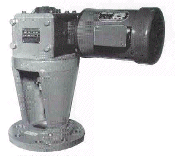 Pedestal
Supports may be made of cast aluminum
of cast iron from our own patterns designed for mixing applications;
or fabricated from steel. They are designed for rugged, rigid,
support of the motor/reducer drive weight, to provide maximum
protection of personnel from moving parts, and to maintain
strict alignment of the impeller shaft with the reducer output
shaft or motor shaft.
Impellar Shafts are selected for
straightness, concentricity, and freedom from mars due to
mishandling. They can be supplied for any length required,
although splicing couplings may be necessary. Critical speeds
are closely watched; shaft diameters are used, which in conjunction
with impeller number, weight, and locations, avoid critical
speed by plus or minus 25%. Shaft materials are selected to
properly handle the corrosive conditions of the specific job
requirements.
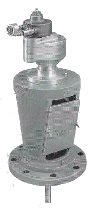 Tank
Seals in the mounting plate or flange
may be flange cartridge bearing, a stuffing box, or a face
type mechanical seal, accurately centered in the flange for
proper shaft alignment.
The Flange Cartridge Bearing is
a doubly sealed ball bearing mounted in a grey iron casting
with an accurately machined tenon drilled for bolting to the
flange (and with a collar having a pair of set screws or a
locking ring for locking to impeller shaft), and a grease
fitting.
The Stuffing Box is usually welded
to the flange center on top side and contains a lantern ring
of suitable material for distribution of lubricant (Teflon
impregnated asbestos or other suitable packing comptible with
tank contents); a grease fitting which may be replaced with
a ram for automatic lubrication; a packing gland designed
to stay put; and with the standard number of bolts for the
pressure involved.
The Mechanical Seal for Vertical
Mixers is double, with a provision for coolant lines. Rotating
head and stationary seat materials are selected for the specific
application. A wear sleeve can be supplied through the seal
which increases the effective shaft diameter. Shaft bearing
support is installed close to seal and rigid alignment is
maintained as is required by such seals.
Couplings, if flexible, used between
motor and reducer input, are either of the rubber spider type
of flexible steel grid type, in order to transfer full motor
torque with a maximum misalignment of 3 degrees. Motors are
shimmed for proper alignment. If rigid, as used between reducer
output and impeller shaft, they are flanged and rabbeted for
absolute alignment. Screws are recessed for safety and tapered
split bushings are used for solid grip of keyed shafts. For
larger mixers, both halves are pinned to support the shaft/impeller
weight. all couplings are shielded, as are all moving parts.
|
|
|


