How,The,EBS,Series,Automatic,Filter,Works

How The EBS Series Automatic Filter Works


Great Pumps...Great Systems...Great 24 Hour Service
Rent or Purchase...Anywhere...Anytime!


Process Controls Home
General
Pumps
Filters & Strainers
Manufacturer
  How The EBS Series Automatic Filter Works
ABF Series | EBS Series | MEGA EBS Series | SAF Series | TAF Series

Filtering Process

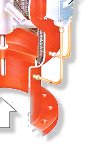
The water flows through the stainless steel cylindrical filter element from inside out, creating minimum head loss. Different types of screens can be used for different filtration needs. The filtration cake accumulating on the  screen surface causes the development of head loss across the screen. When this head loss reaches a pre-set value the cleaning mechanism is operated.


Self- cleaning process

One of two methods of self-cleaning may be selected, depending on the required degree of filtration:
Coarse (3500-200 micron)
Fine (500-10 micron)


How The EBS Series Automatic Filter Works

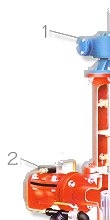
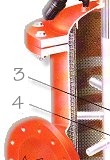
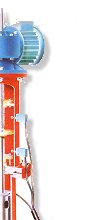
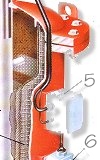
Drawing Key:

1.drive unit
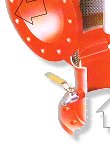
2.exhaust valve
3.suction scanner


4.weavewire screen
5.wiring box
6.pressure differential switch

 
Coarse filtration - Brushes
The brushes are constructed of stainless steel, driven by a 1.5 HP electric motor. The brushes revolve along the screen, thus removing the filter cake  which is then discharged through an exhaust valve  for a duration of 15 to 20 seconds.

Fine filtration - suction scanner
The scanner is driven by a 1.5 HP motor. It scans the screen in a spiral motion and removes the filter cake by suction power created by the exhaust valve opening to the atmosphere. The hollow nozzles of the scanner collect the filter cake which is then discharged through the exhaust valve without touching the screen.
Cleaning takes between 30 to 40 seconds.


Control system

The EBS filter is equipped with a pressostat that transmits an electric signal when the pressure differential across the screen reaches a pre-set value. The signal activates the electronic controller which initiates the flushing cycle.
A solenoid operates the exhaust valve by means of a hydraulic command or compressed air.


Features

  • Flushing according to pressure differential and/or according to time
  • Option for operation of continuos flushing
  • Flushing counter
  • An alarm or an alternative reaction in malfunction mode (open a by-pass, shut-off a pump, operate an alarm signal in control room, etc.


Site Designed By Panther Marketing & Design