|
-
100%
pure chlorine
-
No
loss of strength
-
Constant
dosage rates
-
No
pumps
-
Non-flammable
-
No
moving parts
|
| In
addition, you get the benefit of improved disinfecting
power through the generation of a number of very powerful
mixed oxidants that are produced and fed along with
the chlorine dioxide, among others, give you a more
potent disinfectant.
Compare
SAFE-T-clor with the cost, maintenance, reliability,
and SAFETY of hypochlorite feed systems, both delivered
storage and on-site generated types. You'll find that
there really is no comparison.
Modular
PATENTED design allows expansion of the system as
well as easy maintenance.
|
|
|
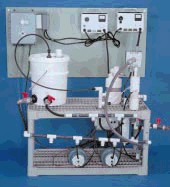
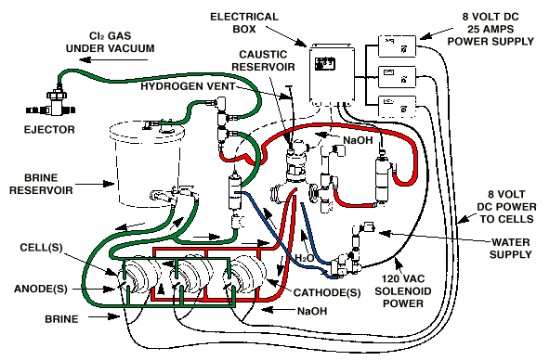
The
SAFE-T-clor chlorine generator utilizes the chloralkali
process to produce chlorine gas. The chloralkali process
involves the separation of sodium chloride (water softener
salt or ordinary table salt) into two elements: chlorine
(Cl) which is released as a gas, and sodium (Na). The
sodium is combined with a hydroxyl ion (resulting from
the decomposition of water) and forms sodium hydroxide,
or caustic soda. Both the chlorine gas and sodium
hydroxide are collected from the generator and used
as beneficial water / wastewater treatment chemicals. |
|
2
NaCl + H2OH + Cl2 ^ + H2^
The
chlorine gas produced by the SAFE-T-clor is maintained
and fed under a vacuum condition. This means that any
leakage, which could occur due to accidental breakage
or other circumstance, will be limited to air entering
the system. A vacuum safety cutoff switch is an
integral part of SAFE-T-clor, and will completely shut
down the chlorine generating process if loss of vacuum
should occur.
|
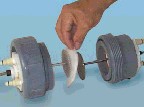
PATENTED "Wedge" cell design simplifies
maintenance. |
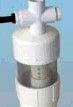
PATENTED caustic density maintenance system. |
Efficient ejector for safe, all-vacuum system. |
Advantages
over other types of chlorination systems:
- LOW
COST: The capital cost of the SAFE-T-clor is several times
less than typical chlorine gas feed systems with containment
and neutralization capabilities. The cost of producing chlorine
with SAFE-T-clor compares with, and is more often lower
than, the cost of purchasing chlorine gas in pressurized
cylinders. The production cost is anywhere from 3
to 8 times lower than hypochlorination systems.
- SIMPLE
OPERATION: There are truly no mechanical moving parts, and
maintenance requirements are very minor. Chlorine gas output
is very accurately adjusted by varying the power input.
- CONSTANT
CHLORINE DOSAGE: The amount of chlorine available in the
salt remains constant regardless of the storage time and
temperature. Hypochlorite solutions weaken (decompose) with
time and temperature.
- SODIUM
HYDROXIDE PRODUCTION: a by product of the generation process
is sodium hydroxide, or caustic soda. Sodium hydroxide is
beneficial chemical used for corrosion control (pH adjustment).
This can reduce the cost of corrosion control treatment
needed to comply with the EPA Lead and Copper Rule, and
can be used for pH balancing in applications such as swimming
pools.
- MODULAR
CONSTRUCTION: modular construction of the patented
generating cells allows easy access and maintenance of electrodes
and membranes.
While
SAFE-T-clor didn't invent the chlor-alkali process, we did spend
over three years in the design of a system that has taken on
site chlorine gas generation to a level of safety and reliability
that is unmatched by any competitor:
DSA
ANODE: some systems utilize the old technology of graphite
anodes. SAFE-T-clor uses a dimensionally stable anode (DSA)
made of titanium and platinum. These anodes offer many
advantages:
- Longer
service life.
- SAFE-T-clor
anodes are not impacted by caustic (NaOH) leakage.
Leakage of caustic into the brine electrolyte causes a premature
wear of a graphite anode.
- As
the graphite anode decomposes, carbon particles released
from the anode react with the available chlorine reducing
the chlorine output efficiency.
- Graphite
anodes produce chlorinated hydrocarbons and volatile organic
chemicals as byproducts of anode decomposition. Several
of the byproduct chemicals are currently regulated as drinking
water contaminants. One of the byproducts is carbon
tetrachloride which has maximum contaminant level (MCL)
of 0.5 parts per billion (ppb).

PATENTED
FLANGED CELLS: The SAFE-T-clor system features a patented
cell design that has significantly improved on-site generation
of chlorine gas:
- Removes
the anodes and membranes from the salt reservoir.
This means that there is no contact with, or disturbing
of, the anode or membrane when adding salt or cleaning the
brine reservoir.
- Allows
quick and easy membrane maintenance and changing, without
removing the salt, or waiting for the salt to be exhausted.
Membranes can be removed and replaced in less than 5 minutes,
compared to units that take hours and require neutralization
of the saturated brine solution.
- System
capacity is easily increased with the addition of cells
and power supplies, up to 6 cells per system. All
of the other components, such as brine and salt reservoir,
caustic reservoir and density control, gas injection, etc
are common for all cells.
- Individual
cells can be removed quickly for maintenance, without disturbing
the operation of the system. Other cells keep generating
chlorine, and cell outputs can be temporarily increased
to maintain dosage rates.
SALT
ADDITION SYSTEM: the salt and brine reservoir is separate
from the cells giving the added advantage of allowing the operator
to easily switch between isolated brine tanks when salt is depleted
and needs to be replenished. Other systems require special
venting to remove the residual gas, which can be a time consuming
process.
PATENTED
CAUSTIC DENSITY MAINTENANCE SYSTEM: This simple system
requires no timers, continuous water flow streams, or other
complicated systems to continuously maintain the caustic at
the optimum density. This is important, because caustic density
must remain in a narrow range for efficient cell operation.
|


