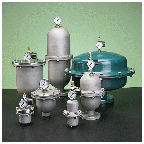
 SENTRY
Hydraulic Surge Suppressors
When fluid in motion
is abruptly stopped, a Hydraulic Surge is created
in the system. Hydraulic Surge is often referred to
as "Water Hammer". The kinetic energy, released as
pressure, can spike up to six times the system's operating
pressure -- destroying system instrumentation, pumps,
pipes, fittings, and valves. Without a suppression
device, the shock wave travels the length of the pipe
back to the pump, then reverses again, ocsillating
back and forth until friction dissipates the pressure
spike or a system component fails.
There are several major culprits that produce this
"Water Hammer" effect -- quick closing valves, back
surge, pump start up and pump shut down. Quick closing
valves can be defined as valves that close within
one and one-half seconds. Quick closing valves have
the potential of stopping large volumes of energized
fluid, producing violent water hammer. Pump start-ups
also stops fluid in motion. During pump start-up,
fluid in a pipe is static and must be accelerated;
the pumped fluid is abruptly stopped when it contacts
the static fluid in the pipe, again creating a chock
wave.
SENTRY Surge Suppressors will absorb the resistance
to acceleration and/or the water hammer surge created
in each situation. As the surge enters the SENTRY
Surge Suppressors, the gas inside is compressed, the
fluid is accumulated and the shock wave is absorbed.
When steady system flow rate is achieved, pressure
ad fluid are slowly released back into the system
by the suppressor.
During pump shut-down and in back surge situations
fluid is reversed. When a pump is shut-off, fluid
will reverse direction due to the differential pressure
created by the momentum of the fluid in motion. In
fact, if the pressure differential is below the vapor
pressure of the fluid, a vapor pocket will form creating
even higher transient pressures. The reversed flow
creates "water hammer" as it slams into the pump's
check valve. This effect is compounded in a back flow
situation, where fluid is pumped over an elevation
or vertically, creating an increase in power due to
the fluid's accelerated velocity.

|


