
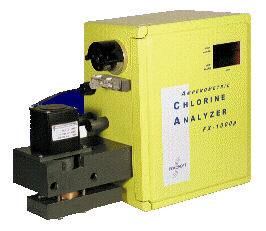
 The
Foxcroft FX-1000p Chlorine Residual Analyzer utilizes the most
accurate test method to determine chlorine residual levels in
process waters, similar to that used in lab environments titrator
test methods. This makes it an excellent choice for chlorine
control or monitoring applications. Residual readings are instantaneous
and do not rely on "sample and hold" methods. This
minimizes any delay in readings for control applications.
The
continuous 4-20 milliamp output signal can be used to drive
chlorine residual control systems and/or chart recorders or
SCADA systems. The alarm outputs can alert plant operators to
an out-of-range chlorine residual, or trigger an autodialer
in remote or off-hour situations.
The
measuring cell design incorporates several features to ensure
accurate readings, such as: high-grade gold and copper electrodes,
fixed sample and buffer feed rates, and continuous cell mixing
and cleaning. Solid-state analog electronics provide stable,
drift-free, residual readings and output signals. Electronic
isolation eliminates problems from "ground-loops"
and ensures operator safety.
The
analyzer is designed to be relatively maintenance-free, other
than adding vinegar when it runs out. The use of vinegar as
a pH buffer is simple, effective, economical, and environmentally
friendly. Converting the analyzer to read total chlorine is
as simple as adding Potassium Iodide to the vinegar buffer.
Features:
• True
Amperometric test method
• Measures
free or total chlorine residuals
• Applications
include fresh water, wastewater, and food processing
• Simple
to calibrate and operate
• Low
maintenance design
• Uses
inexpensive, non-toxic, food-grade vinegar for pH buffering
• Continuous,
isolated, 4-20 milliamp output signal, suitable for control
or monitoring applications
• Built-in
high and low alarm relays
• Field-adjustable
range
• High
range capabilities to 50 PPM without dilution
|
General
Specifications
|
|
Type
of Measurement:
|
|
Amperometric,
free or total chlorine |
|
Readout:
|
|
Digital,
red L.E.D. |
|
Instrument
Ranges:
|
|
Field
adjustable from 0-0.1 to 0-50 PPM (mg/l), factory set for
0-5 PPM |
|
Resolution:
|
|
.001
PPM (mg/l) for ranges to 0.5 PPM, or 0.01 PPM (mg/l) for
ranges above 0.5 PPM |
|
Sensitivity:
|
|
0.001
PPM (mg/l) |
|
Accuracy:
|
|
+/-
0.25 % of full scale |
|
Repeatability:
|
|
0.004
PPM (mg/l) or 1 % of full scale, whichever is greater |
|
Stability:
|
|
+/-
1 % of full scale per month |
|
Speed
of Response:
|
|
4
seconds from sample entry to display and signal response
|
|
Full
Scale Response:
|
|
1.5
to 2 minutes |
|
Sample
Temperature:
|
|
34
to 120 degrees F. (2 to 60 degrees C.) |
|
Sample
Flow Requirements:
|
|
250
ml/min. minimum (includes overflow)
(sample pump required for non-pressurized applications)
|
|
Sample
Cell Use:
|
|
120
ml/min., fixed |
|
Sample
pH:
|
|
3.0
to 10.0 |
|
Sample
Alkalinity:
|
|
0.05
to 300 PPM (total)
(Combined high pH and high total alkalinity may
require pickling vinegar for pH buffering.) |
|
Sample
Turbidity:
|
|
Less
than 250 NTU |
|
Buffer
Requirements:
|
|
5
% Food-Grade Distilled White Vinegar (add Potassium Iodide
for total chlorine residual readings) |
|
Buffer
Use:
|
|
4.5
days with # 14 peristaltic pump tubing, included
13 days with # 13 peristaltic pump tubing, optional
(only for use in fresh water applications, with
low pH and alkalinity) |


