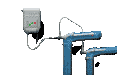
Product
Performance Summary
Typically,
all water used for personal, commercial or industrial
consumption carries in solution or suspension many
different elements and compounds that it has come
in contact with on its journey to the end user.
Many of these are salts, as they are referred to
chemically, and may be in many forms. However, the
most common are those formed by calcium and magnesium
carbonates and their bicarbonates. It is these salts
that are responsible for the general hardness of
any particular water supply. typically, the deposits
formed by these compounds are referred to as scale
or lime deposits.
In
order for these compounds to form deposits, they
must collect together to form particles that have
enough mass and surface charge to be able to overcome
the velocity of the fluid flow within a system.
Once they have attained this mass, they will then
adhere to a piping or heat exchange surface. if
allowed to collect untreated, these deposits can
form in quantities sufficient to effectively restrict
water flow in a piping system, reduce heat exchange
efficiency, speed the various other problems. However,
when these deterioration of your system and generate
salts are subjected to a strong electrostatic field.

The
concept of anelectrostatic water treatment system
utilizes basic electrical technology to create an
electrostatic field. An technology to create an
electrostatic field. An electrode, coated with a
polymer that has a high dielectric constant coupled
with excellent chemical and abrasion resistance,
is charged to 30 KV dc. The dielectric insulator
allows the creation of a strong electrostatic field
between the surface of the electrode and the interior
surface of the treatment chamber or pipe. The insulator
protects the fluid from coming into direct contact
with the charge applied to the electrode.
This
electrostatic field will then control the development
of scale deposits by reducing the size of the particle
collections in solution and by interfering with
their ability to bond together and form deposits.
In addition, the surface tension of the water molecules
passing through the chamber is reduced, which allows
the water to absorb greater quantities of the scale
and deposit forming minerals and carry them away
in suspension. As a result scale that has been formed
within a system will gradually return to solution
'and be carried away with the water flow.
The
daily operating cost of the electrostatic water
treatment system is less than seventy cents and
saves the cost of chemical treatment and the labor
required to remove scale deposits. It is a very
economical means of water treatment.