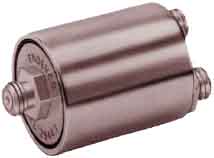
The Endevco Model 2944.1 T-Junction Calibrator provides
all the necessary circuitry and connections for passive
voltage insertion calibration of measurement systems used
with piezoelectric transducers. The voltage insertion
calibration method is a simulation technique that introduces
a voltage into the ground side of the transducer output
signal cable between the transducer and its instrumentation
amplifier to simulate the self-generating output of the
transducer. This simulation is often performed immediately
before and after a test event as in-situ calibration of
the signal conditioning and readout instrumentation. Such
a calibration is required by the MIL-STD-740-2. The simulation
an be performed over a wide range of amplitudes and frequencies.
The Model 2944.1 is a three-terminal network enclosed
in a shielded case. Included in the network is a precision
100 Ohm resistor to close the ground circuit so that measurements
can be made without having to remove the model 2944.1
from the system. Receptacles are provided for attachment
of cables from the transducer, signal conditioner, and
external calibration voltage source.
The voltage insertion method is effective only with isolated
transducers. An isolated mounting stud can be used to
provide the necessary isolation for grounded transducers.
The case of the Model 2944.1 is at amplifier signal ground
and must be isolated from other grounds by at least 10
MOhm to prevent ground loops. An isolated cable clamp
is provided for this purpose.
Voltage insertion calibration is a passive operation and
as such does not provide a dynamic sensitivity calibration
of the transducer. For applications requiring a dynamic
vibration calibration, the Endevco Model 28959 Portable
Shaker System should be used.
Features:
• Permits passive calibration of measurement systems for
piezoelectric transducers
• Small, light weight
• 10-32 receptacles for convenient connection of coaxial
cables
• Aids compliance with MIL-STD-740-2


 The Endevco Model 2944.1 T-Junction Calibrator provides
all the necessary circuitry and connections for passive
voltage insertion calibration of measurement systems used
with piezoelectric transducers. The voltage insertion
calibration method is a simulation technique that introduces
a voltage into the ground side of the transducer output
signal cable between the transducer and its instrumentation
amplifier to simulate the self-generating output of the
transducer. This simulation is often performed immediately
before and after a test event as in-situ calibration of
the signal conditioning and readout instrumentation. Such
a calibration is required by the MIL-STD-740-2. The simulation
an be performed over a wide range of amplitudes and frequencies.


