Clean Harbours, one of the largest Ontario landfill operators, had problems with strong odours emitted from the leachate collected in two lagoons, symptomatic of the incomplete and improper decomposition of solids.
There are two interconnected lagoons on the landfill site. The existing volume of each is five million litres. The wastewater (rain run-off from the landfill) is pumped into the lagoons as needed and this process is controlled by a pumping system.
 More solids are accumulated in the first lagoon because wastewater is pumped by two inlets from landfill to Lagoon 1 and then it flows from Lagoon 1 to Lagoon 2. There are four propeller type surface aerators—two in each lagoon. Each lagoon is aerated and mixed by the aerators.
The wastewater is pumped 24 hours a day into the incinerator where the water is evaporated. The incinerator burns 100,000 litres per week of the lagoon’s water. Forty five buckets of ash from the incinerator is landfilled each week. Each luger bucket is 10 cubic yards. The ash is spread on the landfill and the landfill is then covered by a layer of mixed cement, water and newspaper.
The run-off in the landfill only fills up substantially when the incinerator cannot keep up with rain run-off and the lagoons are full.
Challenge
Hydrogen sulphide, ammonia and volatile fatty acids are common odours associated with the treatment of industrial wastewater. Odours become a serious problem in the summer because of increasing temperatures. Odour issues not only cause concern with local neighbours and residents of the area but are also a potential cost issue for the facility.
Previous Treatment
Clean Harbours originally applied hydrogen peroxide to treat the leachate for odour. It showed a limited odour removal ability both in the lab analysis and in the lagoons. In addition to its limited effect, hydrogen peroxide is also a hazardous product to work with. It is corrosive to mucous membranes, eyes and skin and causes nose and throat irritation.
New Treatment
The existing biological population in a leachate consists of both aerobes and anaerobes. They have specific nutrient and micronutrient requirements for optimal growth and reproduction, many of which may not be present in the leachate environment. This can often become a rate-limiting variable in the processing of wastes, resulting in decreased operating efficiencies, loading rates and/or undesirable by-products, such as excessive odours, scum formation and solids.
BioStreme is a custom engineered micronutrient formulation that is used for the enhancement and acceleration of existing biological treatment systems. Its proprietary formula is derived from 100% all-natural sources of amino acids, plant extracts and food-grade nutrients, which have been blended to encourage the growth and metabolism of existing and/ or introduced bacteria for dramatically improved treatment results and odour control.
The BioStreme Micronutrient Formulation has been specifically developed to enhance growth and reproduction of facultative bacteria through its engineered formulation of optimized essential nutrients thus eliminating the potential rate-limiting variables and associated undesirable byproducts.
Product Application
The longstanding leachate environment is very similar to a septic system’s environment, emitting various types of off gases venting from the lagoon (odours). BioStreme rejuvenates the system (as a source of nutrient) by incorporating the growth and gradual strengthening of facultative bacteria in the lagoon. As this excess population devours the overload, the lagoon’s functional operation improves until treatment can be diminished and maintained minimally as a preventative measure.
Based on the dimensions and depths of the ponds (5,000,000 litres of leachate) and using BioStreme for leachate treatment, a 60% reduction of odour was expected.
 Each lagoon was shocked using BioStreme to achieve 50 ppm concentration in the pond. To shock each pond, 250 litres of BioStreme concentrate was used. The concentrate was initially diluted 100:1 with water, (this was later revised to approximately 20:1) and spread over the surface of each lagoon. The batch mixer mixed the BioStreme and water and provided the appropriate dilution.
Application was done using a mobile water canon with a 1,000 gallons holding tank spraying the mixed solution on the surface. The surface aerators provided accurate mixing. According to the operator, within approximately four to five days, odours were noticeably reduced.
Since the level of leachate changed due to the addition of rain run-off to the lagoons, BioStreme was added to encourage growth. An additional 100 to 150 litres per week (with the dilution of approximately 20:1) was required to treat 1,000,000 litres per week of new incoming leachate and the remaining liquid in the lagoons to maintain odour control.
Although the nature of incoming materials to the lagoons was not completely known, Filter Innovations was able to determine the required concentration and necessary dilution rate of BioStreme to control the odour of the lagoons.
A sample of pond leachate from the operator was treated with various BioStreme formulations to evaluate the potential for reduction of odour. Two separate tests were done to evaluate both the optimal formulation and application rate for this project.
Conclusion
The application of BioStreme has been extremely effective in achieving odour reduction in the leachate environment at Clean Harbours landfill. According to the landfill manager, odours were completely removed from the first lagoon and noticeably reduced in the second one. Downstream of the lagoons, the odours are virtually non-existent. As a result, Clean Harbours is continuing with the BioStreme program.
Case #2
BioStreme achieves odour reduction at King Capon Poultry
By Irene (Aranak) Hassas at Filter Innovations Inc.
King Capon, one of the Ontario’s poultry processing facility, similar to other poultry plants, generates lots of waste water during both processing of birds and cleaning the facility. Reducing or eliminating odours emitted from the wastewater is a constant concern at the plant. King Capon operates throughout the entire year and processes 10,000 birds per week. They use about two million gallons of water per year for processing of birds and cleaning purposes.
 The poultry’s wastewater and rain runoff are both transferred to the wastewater lagoons where they accumulate and gradually evaporate.
Feather, guts, lungs and other parts of chicken that can’t be used by the operator are stored temporarily in a tank until transferred to a rendering plant.
Lagoons Specifications
There are three interconnected lagoons with the depths of six, eight and twelve feet. First lagoon is 65,339 ft² and the second and third are 32,669 ft² each.
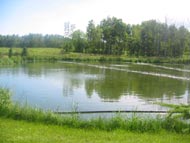 The aeration system in lagoon one consists of thirty shallow bubblers and eight deep bubblers beating the water up all the year. Several bubblers also mix the water of lagoon two and three.
Wastewaster is transferred to the first lagoon via an inlet through the piping system coming from the processing facility. The waste water runs down the slope toward the second and third lagoons via outlets located deeper (about four feet) in the ponds. More solids accumulate in the first lagoon.
Challenge
The general public is demanding elimination of offensive odours and government bodies respond with tighter regulations. Most odour control methods are designed to keep or dissipate odours within the poultry boundary. Odour production cannot be completely prevented on a farm. If methods for containing odours within the boundaries of the farm are insufficient, odour treatment methods may be necessary.
To assist the poultry processing industry in resolving the odour issues released from the leachate in lagoons, Filter Innovations has introduced the idea of eliminating the odour using the cost effective application of BioStreme solution.
New Treatment
 The use of biological processes for the treatment of wastes is an established method for reducing the impact of industrial and municipal pollutants on the environment. The existing biological population in organic wastes consists of both aerobic and anaerobic bacteria. They have specific nutrient and micronutrient requirements for optimal growth and reproduction. Many of which may not be present in environments such as grease treatment facilities (storage tanks) . This can often become a rate-limiting variable in the processing of wastes resulting in decreased operating efficiencies, loading rates and/or undesirable by-products such as excessive odors, scum formation and solids.
BioStreme™ is a custom engineered micronutrient formulation that is used for the enhancement and acceleration of existing biological treatment systems. Its proprietary formula is derived from 100% all-natural sources of amino acids, plant extracts and food-grade nutrients, which have been blended to encourage the growth and metabolism of existing and/or introduced bacteria for dramatically improved results and treatment control.
BioStreme has been specifically developed to enhance growth and reproduction of facultative bacteria through its engineered formulation of optimized sssential nutrients thus eliminating the potential rate-limiting variables and associated undesirable by-products.
Product Application
A sample of pond leachate was treated in lab with BioStreme formulations to evaluate the potential for reduction of odour. Lab results are described in detail in the laboratory analysis report.
Twenty litres of BioStreme was applied on a weekly basis- half on Mon and half on Wed. At the time of application, half a pail is pumped up and sprayed on top of the lagoons for better result.
Conclusion
Filter innovations provided BioStreme Solution for the treatment of leachate at King Capon poultry processing plant. It was reported by the facility that BioStreme was very effective removing odours from the leachate environment.
As stated by the owner of the poultry “the products works very well and is very cost effective”. He also mentioned “We have been using BioStreme since the early spring of this year to keep our lagoons in tip-top working order. Filter Innovations has kept us well within MOE compliance”. “No more malodours” He said.
Our expectation is that 80% plus of all obnoxious odours be eliminated and the remaining odour will not be an issue.
Case #3
BioStreme achieves odour reduction in the treatment of grease waste
By Irene (Aranak) Hassas at Filter Innovations Inc.
One of the largest Ontario operators in the area of collection and transportation of all types of organic residuals, including industrial wastewater treatment sludges and food service facilities grease waste had odour issues, particularly in the processing, storage and transfer of grease wastes. Unpleasant odours were very offensive significantly affecting surrounding communities and employees.
Trucks, Processing Facility and Farm Storage Pits were the main areas of concern that were involved in the handling of grease wastes. Throughout the day, trucks pay visits from one site to another and collect the grease waste. A hose is put in place to pump out the grease.
 When truck tanks are full and the operation is complete, they return to the processing facility, deliver the collected grease trap waste to the interim grease trap waste treatment facility and dump the grease in large tanks at the treatment facility where water and grease are separated. It is then transferred to a farm pit storage site where the grease is stored for several weeks until gradually injected into the ground.
Challenge
The most common complaints received about organic wastes are about odour. During the vacuuming operation of the trucks, strong odour was emitted from the truck as it filled up via tank air displacement. In the processing facility, wastes that were received from outside sources also emitted strong odours.
New Treatment
The use of biological processes for the treatment of wastes is an established method for reducing the impact of industrial and municipal pollutants on the environment.
The existing biological population in organic wastes consists of both aerobic and anaerobic bacteria. They have specific nutrient and micronutrient requirements for optimal growth and reproduction. Many of which may not be present in environments such as grease treatment facilities (storage tanks). This can often become a rate-limiting variable in the processing of wastes resulting in decreased operating efficiencies, loading rates and/or undesirable by-products such as excessive odours, scum formation and solids.
BioStreme™ is a custom engineered micronutrient formulation that is used for the enhancement and acceleration of existing biological treatment systems. Its proprietary formula is derived from 100% all-natural sources of amino acids, plant extracts and food-grade nutrients, which have been blended to encourage the growth and metabolism of existing and/or introduced bacteria for dramatically improved results and treatment control.
BioStreme has been specifically developed to enhance growth and reproduction of facultative bacteria through its engineered formulation of optimized essential nutrients thus eliminating the potential rate-limiting variables and associated undesirable by-products.
Product Application
Due to the severity of odours, Filter Innovations proposed the use of a 200 ppm dosage rate of BioStreme Solid Waste Treatment (SWT) for the initial trial term. BioStreme SWT was premixed with water (min 20:1) and applied into the empty, clean trucks prior to the collection.
| Truck Capacity
(gal) |
# of Truck |
BioStreme SWT req. per Truck |
Premix
Water |
Total BioStreme SWT req. |
| 350 |
3 |
0.3 L |
6 L |
0.9 L |
| 1800 |
8 |
1.5 L |
30 L |
12 L |
| 4000 |
1 |
4 L |
80 L |
4 L |
| 8000 |
2 |
8 L |
160 L |
16 L |
| |
|
|
Total |
32.9 L |
This application procedure allowed the BioStreme SWT formulation to mix and react with newly introduced wastes during filling and transport from location to location thus eliminating or reducing the severity of the odours released via tank air displacement during the filling process.
At the processing facility odour control was aided by an on-going pre-treatment of the wastes in the trucks as well as the existing overhead atomizing system.
For treatment of the four storage pits in the farm (each one million gallon), BioStreme Concentrate is proposed to be applied in an empty pit. The product is to be added directly into the pit during truck discharge at the recommended dosage (50 to 100 ppm). Also, the pits can be shocked just prior to soil injection to minimize odour during this process. The BioStreme will also enhance liquification of the “sludge”.
Conclusion
The malodours were reduced immediately. This was substantiated by facility personnel. The product was reported to be very effective removing the odour from the trucks while trucks being filled with newly introduced grease as well as removing odours from the facility where the grease was stored for several weeks.
The truck drivers also provided positive feedbacks on the application of the product for the clean-up of the facility and removal of strong odour released during spills. As reported by the facility manager, the effect was observed almost immediately followed by the application of BioStreme solution removing the severe odour. Therefore, they are continuing with the BioStreme program with high praise in all applications.
Our expectation is that 70- 90% of all obnoxious odours will be eliminated and the remaining odour will not be an issue.