How
active ionizers function
 Electrostatic
Charges
The subject of these remarks
is what is known as ionizers. lonizers are associated with static
electricity. But how is static electricity defined? It is held
to be a static electrical charge. Static electricity can occur
in insulators or in conductors which are installed ungrounded.
Static electricity can also be
found in nature. A cloud, for instance, can become so statically
charged in a storm that there is a discharge towards earth.
A discharge can also occur when a positively charged cloud meets
a negatively charged cloud. We see these discharge processes
as lightning.
Undesirable electrostatic charges
can also occur in various manufacturing processes. These physical
phenomena can be observed in paper and foil processing, the
plastics processing industry, and the textile industry. The
major factor influencing the amount of static charge is the
electrical conductivity of the material concerned.Other parameters
are the speed of processing and the humidity of air.
Static electricity in industrial
applications can be reduced or eliminated through increased
air humidity, soaking, flame treatment or through ionizers.
Haug specialises in the manufacture
of ionization systems and produces devices, in Switzerland and
Germany, for eliminating static electricity as well as devices
which deliberately charge materials (what are known as charging
generators).

The
origin of electrostatic charges
The origin of electrostatic charges
used to be explained by friction processes (tribo-electricity).
Today, semiconductor physics
puts forward the following theory:
If two materials are brought
into close mechanical contact, an electron migration takes place
within the common barrier layer because of differing electron
work functions. At the common barrier layer, also known as the
Helmholtz double layer, a voltage of a few millivolts is produced
(Illus. 1 ).

Illus. 1 : Electron migration
The barrier layers of both materials
can be regarded as a plate capacitor whose voltage U can be
determined through

where Q is the charge and C the
capacity of the capacitor. On separation of the two workpieces,
their distance increases by several orders of magnitude. The
capacity of the capacitor reduces correspondingly in accordance
with the relationship

| Here |
 |
is
the dielectric constant and |
 |
the dielectricity of the intermediate
layer. A is the area of the capacitor plates. There is therefore
a contact phenomenon. This explains the influence of friction,
since the friction influences the size of the contact area.
On separation of the two workpieces,
the voltage rises considerably (up to 10 kV and more) if the
charge is not balanced (Illus. 2).

Illus. 2: Separation and
residual charge
Measuring
static electricity
It is possible to measure static
electricity indirectly by registering the effects it produces.
Nowadays, field strength meters, which use the influence or
modulation measuring method, are used. These devices operate
without contact and measure the electrical field according to
magnitude and polarity.
Influence measuring sets measure
influence charges, which are generated through the effect of
the electrostatic field of a charged body.
Modulation measuring units use
mechanical modulation to convert the electrostatic field, which
is constant over time, into a periodic quantity which is measured.
This is the principle under which the rotary voltmeter, also
called Feldmühle (field mill), works. In the rotary voltmeter
a capacity is modulated through a rotating wing. We know from

that the charge Q of a plate
capacitor is proportional to the voltage U applied to the capacitor,
where C is the capacity of the capacitor. If equation (3.1 )
is differentiated according to time, we obtain

At the capacitor the applied
voltage U is related to the electrical field strength E of the
field between the plates through the equation

where d is the distance between
the plates. At a constant voltage, (3.2) and (3.3) tell us that

The current i
flowing (and modulated) through the modulated capacity is therefore
proportional to the field strength E.

Interference
caused by electrostatic charges
 |
| Fig.
1: Works illustration, passive ionizer on a warping machine |
In the textile industry,
electrostatic charges are undesirable for a variety of reasons:
Bobbin creel
High electrostatic charges occur here when the thread is separated
from the bobbin. Additional static electricity is produced when
the thread is passed through guide eyelets. The charged material
attracts particles of dirt from the environment. Threads charged
with the same sign repel each other, and threads with opposing
polarity attract each other. The threads flutter and the result
is increased thread breakage.
Take-off device
A statically charged fabric web can only be taken off unevenly.
The forces caused by charges can lead to the fabric winding
itself round rolls and rollers.
Operating personnel
People who approach electrostatically charged fabric can experience
very unpleasant electrical shocks.
 lonizers
 |
| Fig.:
2 Haug high-voltage power pack and ionizing bar |
lonizers generate
ions, which are electrically charged atoms and molecules. In
an electrically neutral atom, the number of protons in the atom
nucleus is identical to the number of electrons in the atom
shell. In an ion, by contrast, the number of electrons is increased
or reduced. Since the electrons carry the negative charge, a
negative ion is produced if the number of electrons in the atom
shell rises. A positive ion has one or more electrons less than
a corresponding electrically neutral atom.
Gaseous constituents of air are
ionized. Solid particles and vapour in the air are charged.
lonizers come in all shapes and
sizes. The most frequently used ionizers are bar-shaped.
Passive
Ionizers
Passive ionizers are constructed
such that metallic tips are connected with the
 |
| Fig.
3: Passive ionizer |
|
earth. If such an ionizer is
brought near a charged material, a corona discharge is induced
in the pins of the ionizer, thereby generating ions.
The effect of passive ionizers
is limited. In general, they are only employed in combination
with active ionizers.
Active
Ionizers
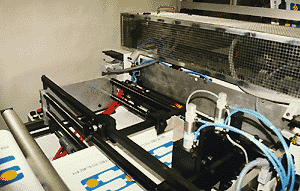 |
| Fig.
4: Active ionizer on an automatic bag forming, filling and
sealing machine |
Active ionizers are manufactured
according to various design principles. Alternating current
devices are the most commonly used. Haug voltage generators
operate at system frequency (50 Hz) and generate a voltage of
approx. 7 kV.
 |
| Illus.
3: Principle of an active ionizer |
In ionizing bars, high voltage
is fed to multiple pins. With Haug ionizing bars, the pins are
not connected directly to the high voltage, but are galvanically
separated from it. This makes Haug ionizing bars safe to touch.
Positive and negative ions are generated at each pin in phase
with the system frequency (Illus. 3); positive ions in the positive
halfwave of the alternating current, negative ions in the negative
half-wave. These ions neutralize charges which are located on
a material below the ionizing bar, since the ions of opposing
polarity are attracted. Redundant ions flow over the sheath
of the bar to the earth. This means that no undesirable charges
are accommodated. An active ionizer of the type described is
therefore self-regulating.
 Air
Assisted Active Ionizers
lonizers of the kind described
in the preceding section have an inherent
 |
| Fig.
5: Haug needle ionizer with suction-blower system for bottle
cleaning |
disadvantage in that their range
is relatively narrow (10 mm up to max. 200 mm). Since ions of
both polarities are generated, the ions generated recombine
at a certain distance from the ionizer. The ions are therefore
neutralized at a greater distance. This phenomenon can be reduced
by conveying the ions away from the ionizer using compressed
air. In this way the effective range of an ionizer can be increased
up to a maximum of approx. 70 cm.
Compressed air is predominantly
used when a surface is to be cleaned. The ionized compressed
air is particularly effective at detaching particles of dust
and dirt. The ionization eliminates the electrostatic forces
binding the particles to the surface.
Haug offers air-assisted ionizers in a wide variety of forms.
There are ring-shaped air-assisted ionizers for manual operation
and for stationary installation. Also available are bar-shaped
ionizers which can be
 |
| Fig.
6: Haug ionizing bar, combined with air-assisted "Jet Streamer"
for the removal of dust from surfaces and for the transport
of generated ions to greater distance. |
complemented by an blast-air
strip, or combined with a pipe fitted with nozzles.
Material
web cleaners
The modern paper, cardboard,
and textile processing industries are placing
 |
| Illus.4:
Haug Static Air, System Dr. Escherich, for the removal
of dust from webs and plates |
 |
| Fig.7:
Factory illustration |
|
increasing demands on the cleanliness
of materials. This is particularly the case when the material
web is to be carried to further processing and when the quality
requirements are high.
In such cases web cleaning systems
are used. Web cleaners combine various techniques. The aim is
to remove fibres, powder and dust from the web. The particles
adhering to the surface of the material are raised through the
ionized blown air and subsequently sucked off. Rotating brushes
are also sometimes used additionally to remove dirt.
Haug offers various web cleaning
systems with a suction width from 30 cm to 2 m. Illus. 4 shows
a web dedusting device fitted with two ionizing bars. A jet
of air flowing between the bars conveys the positive and negative
ions to the surface of the material at an angle. The air whirl
containing the particles of dust is sucked off where the ion
jet meets the surface.