|

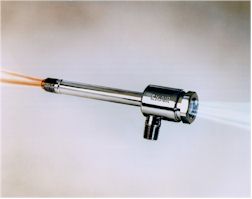
Vortex Tubes
Cold air
to -50°F (-46°C) from your compressed
air supply -- with no moving parts!
 |
Why
EXAIR Vortex Tubes?
EXAIR
Vortex Tubes are constructed of stainless steel.
The wear resistance of stainless steel, as
well as its resistance to corrosion and oxidation,
assures that EXAIR Vortex Tubes will provide years
of reliable, maintenance-free operation. |
|
|
|
|
|
How
a Vortex Tube Works
|

|
| Compressed
air, normally 80-100 PSlG (5.5 - 6.9 BAR), is ejected
tangentially through a generator into the vortex
spin chamber. At up to 1,000,000 RPM, this air
stream revolves toward the hot end where some escapes
through the control valve. The remaining air,
still spinning, is forced back through the center
of this outer vortex. The inner stream gives off kinetic
energy in the form of heat to the outer stream and
exits the vortex tube as cold air. The outer
stream exits the opposite end as hot air. There
is a detailed discussion of vortex tube history and
theory later in this section.
For
more details on the theory behind vortex tubes,
click
here.
|
|
|
Controlling
Temperature and Flow in a Vortex Tube
 |
|
Cold
airflow and temperature are easily controlled
by adjusting the slotted valve in the hot air
outlet. Opening the valve reduces the cold
airflow and the cold air temperature. Closing
the valve increases the cold airflow and the
cold air temperature. The percentage of
air directed to the cold outlet of the vortex
tube is called the "cold fraction".
In most applications, a cold fraction of 80%
produces a combination of cold flow rate and
temperature drop that maximizes refrigeration,
or Btu/hr. (Kcal/hr.) output of a vortex tube.
While low cold fractions (less than 50%) produce
lowest temperatures, cold airflow rate is sacrificed
to achieve them.
|
Most
industrial applications, i.e., process cooling, part cooling,
chamber cooling, require maximum refrigeration and utilize
the 3200 series Vortex Tube. Certain "cryogenic"
applications, i.e., cooling lab samples, circuit testing,
are best served by the 3400 series Vortex Tube.
Setting
a vortex tube is easy. Simply insert a thermometer in
the cold air exhaust and set the temperature by adjusting
the valve at the hot end. Maximum refrigeration (80%
cold fraction) is achieved when cold air temperature is
50°F (28°C) below compressed air temperature.
 |
If
you are unsure of your flow and temperature requirements,
EXAlR recommends the purchase of an EXAIR Cooling
Kit. It contains a vortex tube, cold air muffler,
air line filter and all generators required to experiment
with the full range of airflows and temperatures.
|
|
Model
3930 Cooling Kit
|
|
 PDF
Download Brochure |
Price
List Link

|