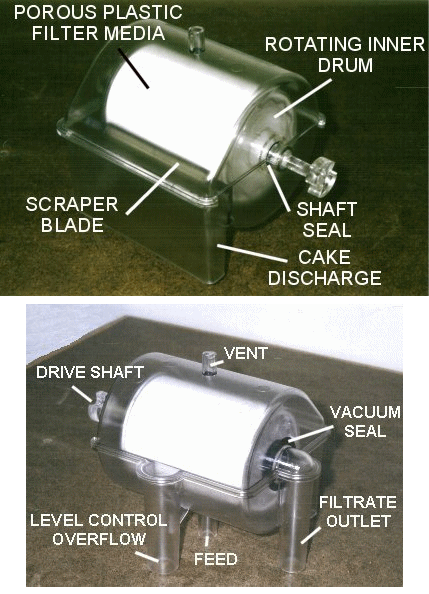
 Traditionally the Rotary Drum Filter has not
been applicable in small to medium volume
production applications. This is primarily
due to the complicated mechanical construction
of a typical filter designs that originally
arose from in the CPI. In the design of these
existing devices engineering detailing the
rotation mechanism, shaft seals, etc. usually
made them too expensive to directly "scale-down"
to a size that would be appropriate for use
in the small to medium volume applications
seen in the Pharmaceutical, Fine Chemical,
and beverage industries.
 The
operation of the Disposable Rotary Drum Filter
is analogous to all vacuum drum filters. These
filters are made up of an inner rotating drum
encased in an outer cylinder or half-cylinder
(trough). The slurry enters the outer cylinder
or trough and settles in the bottom. The level
is controlled so that the inner drum's surface
is covered to 30% - 35%. The surface of the
drum is covered with a filter fabric. A vacuum
is pulled on the inside of the drum, pulling
filtrate into the inside and depositing the
solids on the fabric. The filtrate is pulled
into channels in the interior of the drum
and routed out of the device. The system is
made continuous by rotating the drum. As it
rotates out of the liquid, the solids start
to dry as air passes though them via the vacuum
on the drum. When the drum completes its revolution
the surface comes in contact with a scraper
or knife blade, which removes the solids that
have accumulated. The drum continues rotating
back into the slurry and the process starts
all over again.
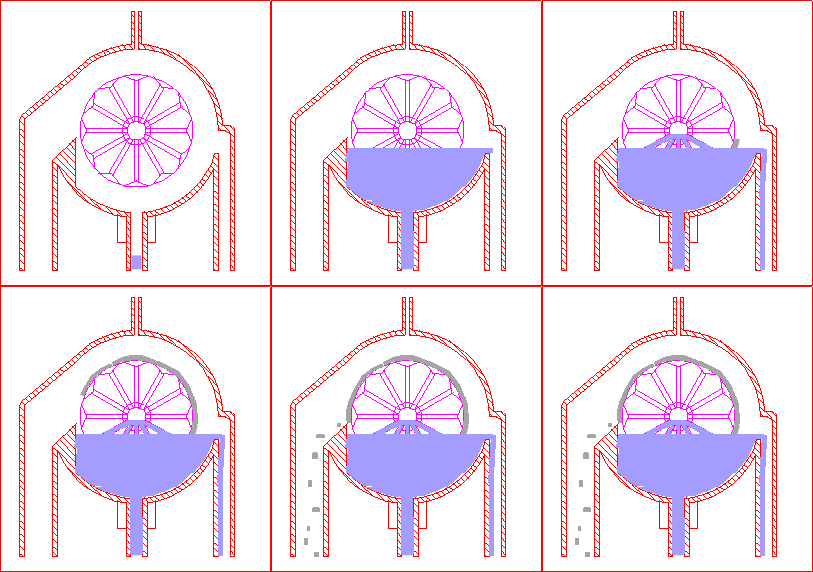 Once
the device has reached steady state, the drum
is fully covered with the solids cake for
the first time, then the device can operate
for hours or days taking in slurry and discharging
clarified filtrate and dried solids continuously.
The main advantage of this over a batch operation
being that large amounts of slurry can be
processed in a small enclosed device, minimizing
manpower, operating space, and HVAC resources.
Operation
| Operational
Flowsheet | Filtration
Area | Materials


